Smart Factories 2027: How AI Agents Are Revolutionizing Production Lines in China and Beyond
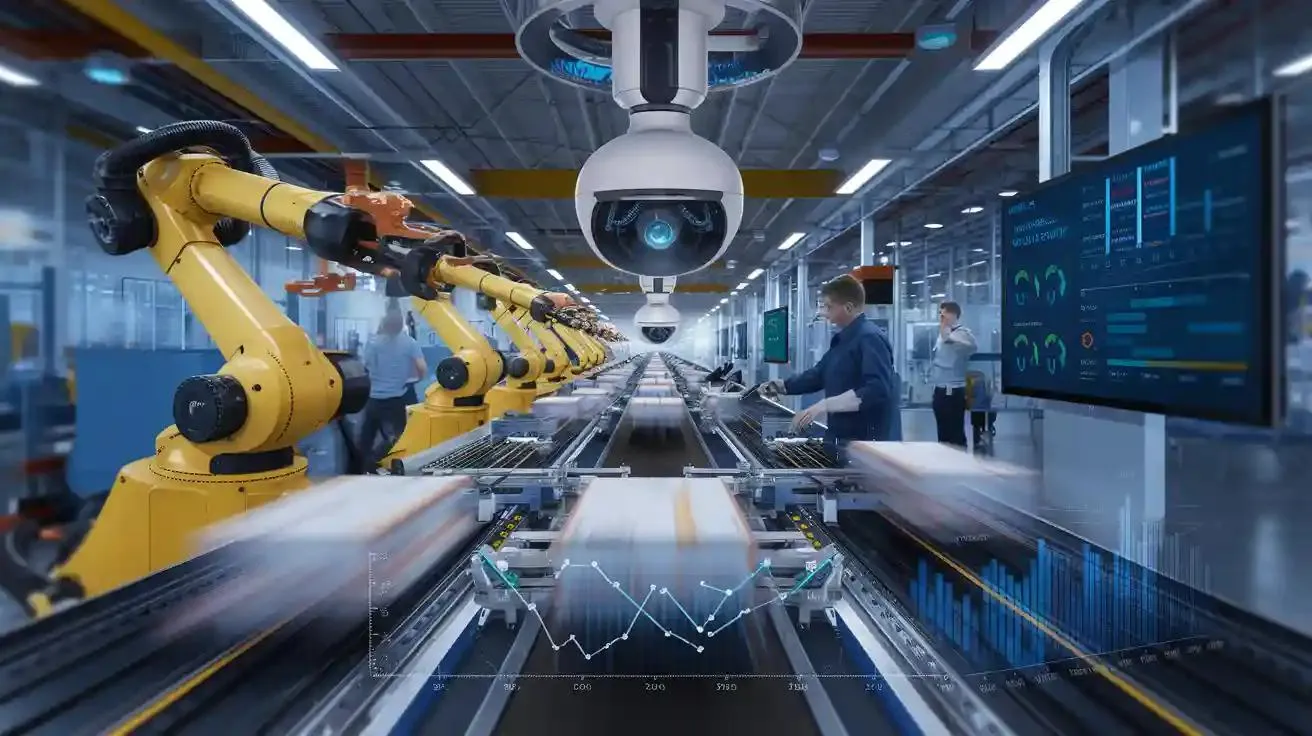
Meta description: Discover how AI agents are changing smart factories in 2027, from predictive maintenance and quality control to production planning, robotics, and industrial AI governance.
Introduction: From connected machines to coordinated decisions
A modern factory can generate a huge stream of operational information: machine telemetry, inspection images, production schedules, inventory updates, maintenance records, and energy data. Connecting those sources is an important step toward smart manufacturing, but connectivity alone does not guarantee better decisions.
The next step is to make that information useful across workflows. AI agents—software systems that can interpret context, use approved tools, and carry out bounded multi-step tasks—are being explored for activities such as investigating production delays, coordinating maintenance workflows, summarizing quality issues, and recommending schedule changes.
China is a major manufacturing ecosystem and an important setting for observing the development of industrial automation, robotics, and connected production. But the opportunity extends well beyond China: manufacturers in Europe, North America, India, Southeast Asia, and other regions face similar pressures around quality, resilience, workforce capability, energy use, and production flexibility.
The important distinction is that an AI agent is not a replacement for a programmable logic controller (PLC), a safety system, or a validated manufacturing execution system (MES). In a well-designed architecture, agents help interpret information and coordinate permitted workflows while deterministic controls continue to manage machine behavior and safety-critical operations.
This guide explains where AI agents can add value in smart factories in 2027, how to integrate them with existing industrial systems, and how manufacturers can build a practical, measurable adoption plan.
1. What makes a factory “smart” in 2027?
Smart manufacturing combines connected equipment, operational data, automation, analytics, and people into a more observable and adaptable production environment. The exact technology mix varies by plant, but common components include:
- Industrial control systems: PLCs, distributed control systems, robot controllers, and supervisory control and data acquisition (SCADA) systems.
- Manufacturing execution systems: MES platforms that track production orders, work in progress, routing, and shop-floor execution.
- Enterprise systems: ERP, supply-chain planning, procurement, and inventory management.
- Industrial Internet of Things (IIoT): Sensors and gateways that collect equipment, environmental, and process data.
- Machine vision and quality systems: Cameras, inspection models, test equipment, and defect-management workflows.
- Digital twins and simulation: Models of equipment, production cells, or entire processes used for analysis and scenario testing.
- Analytics and AI: Forecasting, anomaly detection, optimization, generative AI, and increasingly agentic workflows.
These systems serve different purposes. Traditional automation excels at repeatable, bounded control. Predictive models estimate what may happen next. Generative AI can summarize and interpret unstructured information. An AI agent can combine information with tools to progress through a defined workflow—for example, assembling evidence about a machine fault, checking approved maintenance procedures, and preparing a work order for review.
The strongest designs use each technology for the job it handles best instead of placing an LLM in the middle of every control loop.
2. What is an AI agent in a manufacturing environment?
An AI agent is more than a chatbot that answers questions about a factory. It is a software component that can receive a goal, inspect permitted information, choose from approved actions, and continue through multiple steps while following constraints.
Consider a production line that begins producing more rejected parts than usual. A bounded quality-support agent might:
- Detect an alert from an approved quality-monitoring system.
- Retrieve recent inspection results and relevant machine events.
- Compare the event with documented process limits and known issue records.
- Summarize plausible causes with links to the underlying evidence.
- Recommend checks for a qualified engineer or operator.
- Prepare a quality ticket or maintenance request for approval.
- Record the decision and outcome for later evaluation.
The agent should not independently change machine parameters or bypass an interlock simply because its analysis suggests a likely cause. High-impact actions need deterministic validation, authorization, and appropriate human approval.
Agent patterns that can be useful on the shop floor
| Agent pattern | Example task | Appropriate boundary |
|---|---|---|
| Troubleshooting assistant | Correlate alarms, maintenance notes, and manuals | Read-only investigation; recommendations reviewed by staff |
| Maintenance coordinator | Assemble evidence and draft work orders | Scheduling or work-order creation limited by role and approval rules |
| Quality investigator | Summarize defects and retrieve inspection history | No autonomous acceptance of safety-critical products without validated controls |
| Production-planning assistant | Compare schedule options against constraints | Propose changes; planning system and authorized staff approve commits |
| Energy analyst | Identify unusual consumption and suggest operating windows | No changes to equipment settings without validated control logic |
| Materials coordinator | Flag shortages and prepare replenishment requests | Purchasing and supplier commitments remain permission-controlled |
The word “agent” does not itself imply autonomy, reliability, or industrial suitability. The useful question is: which decisions can the system make, which tools can it call, and what controls prevent an incorrect action from affecting production?
3. China and the global smart-factory landscape
China’s manufacturing scale, industrial supply chains, and investment in automation make it a significant market to watch. At the same time, manufacturing capabilities differ widely by sector, region, company size, and individual plant. It is misleading to treat every Chinese factory—or every factory elsewhere—as equally automated.
Several broad trends are relevant to manufacturers evaluating AI agents:
- More connected production assets: Better access to machine and process data creates opportunities for diagnostics and workflow coordination.
- Robotics and machine vision: Automated handling and inspection can provide structured events that analytics and agents can help interpret.
- Digital-twin initiatives: Simulation and virtual process models can support what-if analysis before a change reaches the physical line.
- Pressure for flexibility: Shorter product cycles and changing demand increase the value of tools that help teams assess schedule and configuration trade-offs.
- Supply-chain coordination: Factory decisions depend on supplier lead times, inventory, logistics, and upstream constraints—not only on local machine performance.
These patterns are not unique to China. Manufacturers elsewhere are pursuing similar goals, shaped by different labor markets, energy prices, regulations, legacy systems, and investment capacity. A successful approach should be based on a plant’s operational requirements rather than a country-level narrative or a vendor’s broad claims.
For cross-border deployments, teams should also consider data residency, cybersecurity requirements, supplier access, export controls where relevant, and the practical ability to support systems across sites and time zones. The right architecture may differ between a highly connected new facility and a brownfield plant with older equipment and limited network access.
4. Five high-value use cases for AI agents in production
4.1 Predictive maintenance and fault investigation
Predictive maintenance models can identify patterns associated with equipment degradation, while an agent can help turn alerts into an actionable investigation. It might collect sensor trends, review prior maintenance events, find the relevant procedure, and draft a work order with the evidence attached.
The value is not merely generating a plausible explanation. It is reducing the manual effort required to assemble trustworthy evidence and helping maintenance teams prioritize the next step.
Implementation tips: Start with one asset class and a known failure mode. Validate alert quality against maintenance records, distinguish correlation from cause, and track false alarms as well as missed failures. Keep equipment shutdown and restart decisions under approved control procedures.
4.2 Visual quality inspection and defect analysis
Machine-vision systems can classify visible defects or identify deviations from a reference. An AI agent can aggregate inspection results by product batch, line, shift, or machine and help engineers investigate patterns across quality reports and process logs.
For example, if a particular defect appears more frequently after a tooling change, the system can assemble the timeline, retrieve the change record, and present relevant inspection images for review. This helps people investigate faster without treating the agent’s suggested cause as proven.
Implementation tips: Use representative labeled data, monitor performance as products and lighting change, preserve traceability to inspection evidence, and define escalation thresholds. Keep validated inspection rules and required product-release controls intact.
4.3 Production scheduling and changeover planning
Production scheduling is a constraint-heavy problem involving due dates, machine capacity, tooling, materials, staffing, maintenance windows, and changeover time. AI agents can help explain conflicts, compare candidate schedules, and gather the information planners need to make a decision.
A useful workflow is to have an optimizer or scheduling engine generate feasible options, then use an agent to explain trade-offs in plain language and prepare a proposed plan. A validated planning system should enforce hard constraints; the language model should not invent capacity or silently relax requirements.
Implementation tips: Begin with advisory recommendations, expose the assumptions behind each proposal, and measure schedule adherence, changeover impact, and planner rework. Require authorized approval before committing changes to the production schedule.
4.4 Robotics and human-machine coordination
Robots, autonomous mobile robots, conveyors, and human-operated workstations must coordinate within defined physical and operational limits. AI agents can assist with higher-level orchestration—for example, summarizing a blocked route, coordinating a service request, or recommending a revised task sequence.
They should not replace certified safety functions, collision-avoidance mechanisms, robot controllers, or validated motion-planning systems. Natural-language reasoning is not a safety guarantee, and a generated instruction should never bypass a protective stop or interlock.
Implementation tips: Keep agents outside safety-critical control loops. Expose only approved commands through a policy-enforcing interface, simulate proposed changes where feasible, and test failure handling before a live pilot.
4.5 Energy and resource optimization
Energy use can vary with production mix, idle time, equipment state, compressed-air demand, heating and cooling, and shift schedules. An agent can combine energy dashboards with production context to identify unusual consumption, explain possible contributors, and recommend opportunities for review.
For example, it might flag equipment that remains in a high-consumption standby state outside planned production hours. A facilities or operations specialist can then verify whether the pattern is expected and decide whether a control change is appropriate.
Implementation tips: Normalize consumption against output and operating conditions where possible. Track both energy indicators and production outcomes, and avoid recommendations that compromise product quality, equipment health, or worker safety.
5. Reference architecture: Connect agents without compromising control
A practical industrial AI architecture separates data collection, reasoning, action authorization, and real-time control.
Design principles
Read before write. Start with read-only access to production events, manuals, and work orders. Introduce write permissions only when the workflow and failure modes are well understood.
Use explicit tool contracts. Each tool should have a documented purpose, input schema, allowed roles, validation rules, timeout behavior, and audit record.
Separate language reasoning from hard constraints. Use deterministic systems for limits, calculations, scheduling constraints, and safety conditions where appropriate. An agent can explain a result without being the authority that enforces the constraint.
Preserve provenance. Recommendations should link to the alarms, inspection results, procedures, or records that support them. Staff need to be able to verify the evidence.
Plan for degraded operation. Decide what happens if the model, network, retrieval service, or data source becomes unavailable. Core production and safety functions must continue according to the plant’s established operating design.
6. Integrating with legacy equipment and industrial standards
Many plants cannot replace existing systems simply to adopt AI. A realistic strategy works with established controls and adds a carefully governed data and workflow layer.
Industrial connectivity may involve OPC UA, MQTT, historians, vendor APIs, or gateway-based integrations, depending on the environment. These technologies are not interchangeable, and the correct choice depends on device support, network architecture, latency needs, security requirements, and the plant’s existing standards.
Before connecting an agent to a production environment:
- Map assets, data owners, network zones, and trust boundaries.
- Identify which systems are authoritative for production state, maintenance status, and quality release.
- Define read-only and write-capable interfaces separately.
- Validate timestamps, units, asset identifiers, and missing-data behavior.
- Test integration in a development or simulation environment first.
- Document how changes are reviewed, deployed, and rolled back.
Do not allow a convenience integration to create an uncontrolled bridge between enterprise IT and operational technology (OT). Network segmentation, access management, patching, and monitoring remain essential. Industrial cybersecurity frameworks such as the ISA/IEC 62443 series can help teams structure their security program, alongside applicable organizational and regulatory requirements.
7. Safety, cybersecurity, and governance for industrial agents
AI agents introduce risks beyond those of traditional automation because they interpret variable inputs and may call multiple tools. A system may encounter incomplete sensor data, misleading maintenance notes, manipulated documents, prompt injection in retrieved content, or a tool response that conflicts with the current machine state.
A governance plan should cover at least the following areas:
- Identity and least privilege: Give each agent only the access required for its assigned workflow.
- Input validation: Check data types, units, timestamps, ranges, and source authenticity before using operational data.
- Tool allowlists: Restrict actions to explicitly approved operations; do not expose unrestricted shell access or arbitrary control commands.
- Human approval: Require review for consequential actions such as changing a production plan, releasing product, or initiating a disruptive maintenance procedure.
- Safety separation: Keep emergency stops, interlocks, protective functions, and validated control logic independent of generative reasoning.
- Auditability: Record tool calls, approvals, outcomes, model and prompt versions, and relevant evidence without retaining unnecessary sensitive data.
- Adversarial testing: Test malformed inputs, unavailable systems, conflicting instructions, stale information, and malicious content in documents.
- Lifecycle ownership: Assign responsibility for model updates, evaluations, incident response, and retirement.
For higher-risk use cases, perform a formal risk assessment with OT engineers, cybersecurity specialists, safety professionals, and operators. A successful demonstration does not establish that a system is safe for unattended production use.
8. Measuring ROI: Start with the baseline, not the AI claim
Manufacturers should avoid evaluating an AI-agent project only by the number of tasks it completes or the sophistication of its interface. Business value depends on whether the workflow improves measurable outcomes without introducing unacceptable risk or overhead.
Potential metrics include:
| Area | Example measures | Important caveat |
|---|---|---|
| Maintenance | Time to investigate, repeat faults, planned versus reactive work | A shorter investigation is not proof of fewer failures |
| Quality | Defect escape rate, inspection rework, time to identify a pattern | Adjust for product mix and inspection changes |
| Scheduling | Schedule adherence, planner effort, changeover impact | Respect hard capacity and delivery constraints |
| Energy | Energy per unit, idle consumption, peak demand | Normalize for production volume and conditions |
| Operations support | Time to find procedures, ticket completeness, escalation quality | Validate that answers are correct and evidence-backed |
| Reliability and risk | Unauthorized actions, policy violations, downtime attributable to the system | Some critical controls should be zero-tolerance requirements |
Use a clear baseline and compare like with like. Account for integration, hardware, model inference, licensing, maintenance, cybersecurity, training, and downtime costs. A pilot should have a named owner, a defined measurement period, a comparison method, and explicit criteria for stopping or expanding.
9. A practical 90-day adoption roadmap
Days 1–30: Select and scope one workflow
- Interview operators, maintenance staff, quality engineers, and planners.
- Map the existing workflow and its data sources.
- Choose a repetitive, information-heavy task with a clear owner.
- Establish baseline metrics and risk boundaries.
- Confirm data access, network, and compliance requirements.
Deliverable: A use-case brief with a baseline, success criteria, and approved data scope.
Days 31–60: Build an advisory pilot
- Connect to a limited set of approved data sources.
- Build retrieval over relevant procedures and historical records where useful.
- Add a read-only agent workflow with evidence-linked outputs.
- Test against known incidents and representative edge cases.
- Ask operators and subject-matter experts to review outputs.
Deliverable: A controlled pilot that produces recommendations but does not directly change machine behavior.
Days 61–90: Validate operational readiness
- Measure performance against the baseline.
- Test failure modes, access boundaries, and degraded operation.
- Add approval-gated workflow actions only where justified.
- Document support, monitoring, rollback, and incident procedures.
- Decide whether to scale, revise, or stop the pilot.
Deliverable: An evidence-based deployment decision and an operating plan.
Only after a workflow demonstrates value and passes its required reviews should the organization consider broader permissions or deployment across additional lines and sites.
10. What manufacturers should expect next
AI agents are likely to become more useful as industrial data quality, model capabilities, and integration patterns improve. However, progress will not be uniform across plants. The next phase is likely to focus less on giving a model unrestricted control and more on making bounded workflows dependable.
Areas worth watching include:
- Multi-system workflow coordination: Agents that gather evidence across MES, ERP, maintenance, quality, and supply-chain systems.
- Digital-twin-assisted planning: Using simulation to test candidate schedules or interventions before a human authorizes them.
- Smaller and edge-deployed models: Running selected inference tasks near equipment when latency, connectivity, or data-handling needs justify it.
- Multimodal operations support: Combining text records, time-series data, images, and structured machine events with explicit validation.
- Better evaluation and traceability: Measuring not only answer quality but tool reliability, policy adherence, and business outcomes.
- Human-centered design: Building interfaces that help operators understand evidence, uncertainty, and available choices rather than hiding decisions behind automation.
These are directions to evaluate, not guaranteed outcomes or claims that every factory will adopt the same architecture by 2027. Each organization should base investment on demonstrated operational value and its own risk tolerance.
Conclusion: The smart factory is a systems-engineering challenge
AI agents can help manufacturers connect operational information to useful action: investigating faults, organizing maintenance, analyzing defects, comparing production plans, and surfacing resource inefficiencies. Their potential is strongest where work crosses multiple systems and requires people to assemble evidence before taking a decision.
But manufacturing is not a place to confuse fluent reasoning with control authority. Reliable deployment depends on clean data, clear permissions, deterministic constraints, safety separation, measurable outcomes, and operator trust. China and other manufacturing regions may differ in infrastructure and investment priorities, yet these engineering fundamentals apply across markets.
For manufacturers considering the next generation of smart factories, start with one bounded workflow, prove its value against a baseline, and keep critical controls authoritative. At Raxon Labs, the practical path to industrial AI is to combine useful agent capabilities with disciplined integration, security, and validation—then scale only when the evidence supports it.
Frequently asked questions
What is an AI agent in smart manufacturing?
It is a software system that uses context and approved tools to complete a bounded multi-step task, such as investigating a machine alert or preparing a maintenance request. Its permissions and decision boundaries should be explicit.
Will AI agents replace PLCs or industrial control systems?
They should not replace safety-critical control functions. PLCs, robot controllers, interlocks, and validated control systems remain responsible for their defined real-time and safety functions. Agents can support analysis and approved higher-level workflows around them.
How can factories use AI agents without risking production?
Start with read-only advisory use cases, restrict data and tool access, test against known scenarios, require approval for consequential actions, and maintain independent safety systems and rollback procedures.
Does a smart factory need to replace its legacy equipment?
Not necessarily. Many projects can begin through approved gateways, historians, and existing system APIs. Integration feasibility depends on data access, equipment support, network segmentation, and the plant’s security and reliability requirements.
How should a manufacturer measure the ROI of industrial AI?
Define a baseline and track relevant operational measures such as investigation time, quality outcomes, schedule adherence, or energy per unit. Include integration, maintenance, infrastructure, training, and risk-control costs in the evaluation.
Further reading
- NIST: Artificial Intelligence Risk Management Framework
- NIST: Guide to Operational Technology Security, SP 800-82
- OPC Foundation
- International Society of Automation: ISA/IEC 62443 overview
- World Economic Forum: Advanced manufacturing and production
Industrial AI capabilities, regulations, and implementation practices continue to evolve. Validate claims and architecture choices against current standards, vendor documentation, and the operating conditions of the specific plant.