The Hidden Cost of AI: Energy, Water, and the Quest for Green Computing
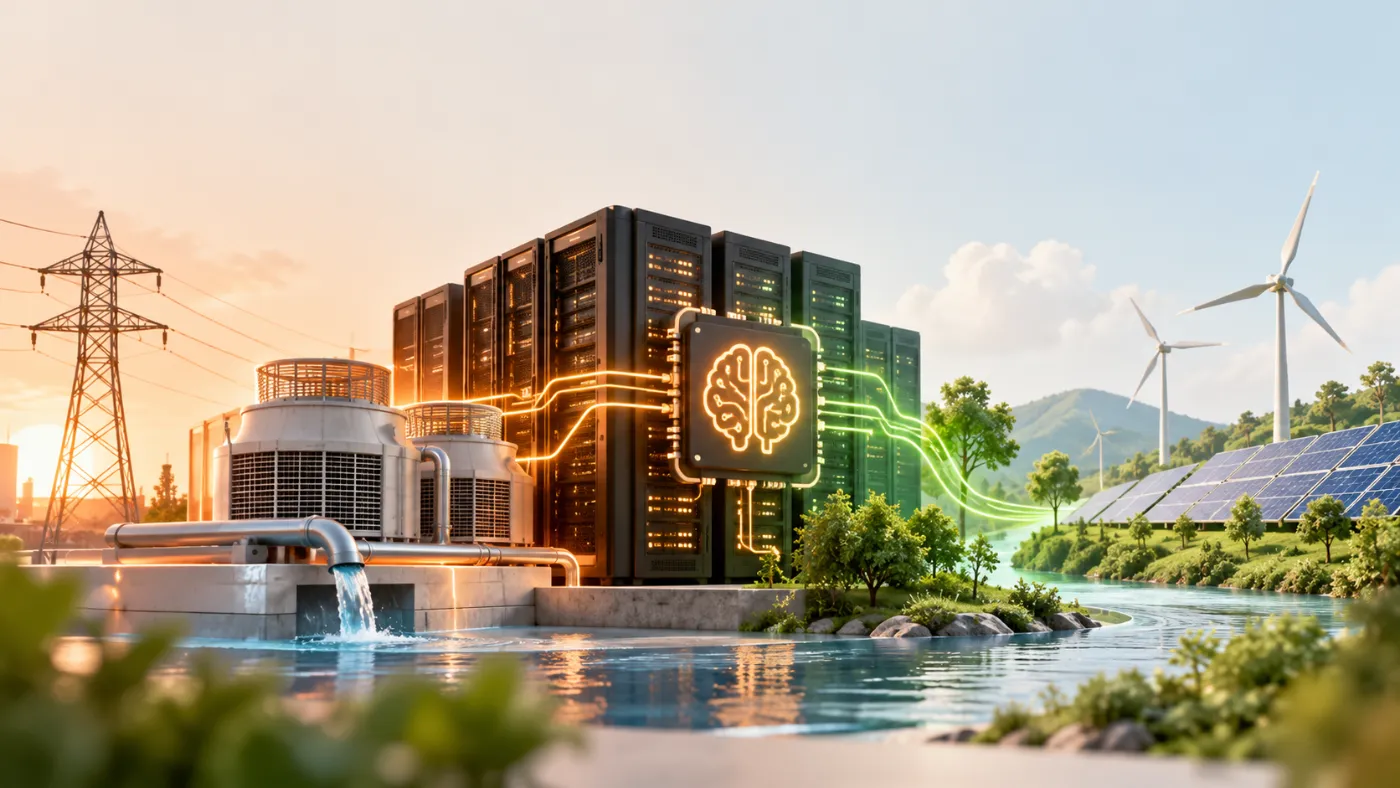
Artificial intelligence can help businesses analyze information, automate repetitive work, improve customer experiences, and discover patterns that would be difficult to find manually. But AI does not operate in a virtual world without physical consequences. Behind every model are data centers, computer chips, electricity systems, cooling equipment, buildings, and supply chains.
As AI use expands, its environmental footprint is becoming an important question for technology leaders, sustainability teams, and business decision-makers. How much energy does AI consume? Why does water matter? What can organizations do to reduce the impact without giving up useful innovation?
The answers are more nuanced than a single number. AI's environmental impact depends on the model, hardware, workload, data-center design, local electricity mix, cooling method, and how often a system is used. Training a large model can be resource-intensive, but serving that model to millions of users also consumes energy. Water may be used directly for cooling and indirectly in electricity generation and hardware manufacturing. And efficiency gains can be offset when lower costs encourage much greater use.
Understanding these trade-offs is the first step toward green computing: designing, operating, and using technology in ways that deliver value while reducing unnecessary resource consumption and environmental harm.
Why AI Has a Physical Footprint
AI systems rely on computation. Training models involves processing large amounts of data and updating model parameters over many computational steps. Once a model is deployed, inference—the process of generating an answer, prediction, image, or other output—requires computing resources each time it runs.
That computing takes place on processors housed in data centers or other devices. These facilities need electricity not only for computation, but also for networking, storage, power conversion, cooling, lighting, and supporting infrastructure. The equipment also has an environmental footprint before it is switched on: chips, servers, batteries, cooling systems, and buildings require materials, manufacturing, transportation, and eventual disposal.
It is useful to think about AI's footprint across its life cycle:
- Development and training: computing used to build or adapt a model.
- Deployment and inference: computing used to answer requests or perform tasks.
- Infrastructure: data centers, networking, storage, and cooling.
- Hardware life cycle: raw materials, manufacturing, transportation, maintenance, and end-of-life treatment.
- Business use: the additional computation created by how often and how extensively people use the system.
A responsible assessment considers the whole system, not just the electricity used by a model during one benchmark or training run.
The Energy Cost of AI
Training is only part of the story
Training a large AI model can require substantial computing over an extended period. The energy used depends on factors such as model size, training data, hardware efficiency, training duration, and whether experiments are repeated or abandoned.
However, focusing only on training can miss a major part of the picture. Once a model is available, it may serve an enormous number of requests. Each request uses computing resources, and the cumulative energy depends on the volume and complexity of those requests, the model architecture, the hardware, and how efficiently the system is operated.
For widely used products, inference can become a significant source of ongoing energy demand. A short text response, a long reasoning task, image generation, and video generation do not necessarily have the same computational cost. It is therefore misleading to assume that every AI request consumes an identical amount of energy.
Data centers need more than processor power
The electricity consumed by servers is only part of a data center's total energy use. Facilities also need cooling, power distribution, backup systems, and other supporting infrastructure. A common measure is Power Usage Effectiveness (PUE), which compares total data-center energy use with the energy used by IT equipment. A lower PUE indicates less overhead relative to IT energy, but it does not by itself reveal a facility's total environmental impact or the carbon intensity of its electricity.
The source of electricity matters as well. The same computing workload can produce different operational greenhouse-gas emissions depending on whether it is powered by a carbon-intensive grid or lower-carbon electricity. Timing and location matter because electricity systems vary by region and hour.
Why rising efficiency does not automatically reduce total impact
AI hardware and software continue to improve. More efficient chips, optimized models, better scheduling, and higher utilization can reduce the resources required for a given task.
But efficiency can also make AI cheaper and easier to use, leading to more requests, larger workloads, and new applications. This is sometimes called a rebound effect: savings per task may be partly or fully offset by growth in total demand. The result depends on how quickly efficiency improves compared with how quickly usage expands.
For businesses, the right question is not just “Is this model more efficient?” It is also “How much total computation will our use case create, and does the resulting value justify it?”
Water: The Often-Overlooked Resource
Energy is only one part of AI's environmental footprint. Water also matters, especially in areas where water is scarce or competing demands are high.
Direct water use in data centers
Some data centers use water-based cooling systems, including evaporative cooling, to remove heat from computing equipment. Depending on the design and operating conditions, these systems can use significant amounts of water. Other facilities rely more heavily on air cooling, closed-loop systems, or different cooling technologies, each with its own trade-offs in energy use, cost, and performance.
There is no single water-use figure that applies to all AI workloads or data centers. Water consumption can vary with local climate, cooling design, server utilization, and operational practices. A facility's annual water use also does not tell the whole story unless it is considered alongside the local watershed and seasonal water availability.
Indirect water use from electricity
Water can also be used to generate electricity. The amount varies by generation technology and location. As a result, a data center may have a water footprint beyond the water used at the facility itself.
This distinction matters because reducing on-site water use does not necessarily minimize total water impact. A cooling design that uses less water might require more electricity, while a different electricity supply could change the indirect water footprint. Good decisions require looking at the local energy and water context together.
The importance of location
A data center's water use has different implications in a water-abundant region than in a drought-prone basin. The same volume of water can create very different local pressures depending on availability, competing users, and the source of the water.
Businesses should therefore look beyond a global average. Useful questions include: Is the facility located in a water-stressed area? Does it use potable water or reclaimed water? How does consumption change during hot or dry periods? Does the operator report water use transparently and explain the local context?
Beyond Energy and Water: Hardware, Materials, and E-Waste
AI infrastructure also depends on physical equipment. Accelerators, servers, networking hardware, and storage systems require materials and industrial manufacturing. Producing this equipment consumes energy and resources, while mining and processing materials can have environmental and social consequences.
Hardware also has a useful life. Rapid performance improvements can create pressure to replace equipment sooner, even when older machines remain functional. Retiring equipment creates a need for responsible reuse, refurbishment, recycling, and secure data destruction.
The environmental cost of hardware is not captured by looking only at a data center's electricity bill. For some decisions, extending server life, improving utilization, or buying equipment with credible environmental information may be as relevant as optimizing runtime energy.
Organizations should consider the full life cycle when making infrastructure decisions, including manufacturing impacts, expected service life, repairability, reuse, and end-of-life management.
Green Computing: What Does It Actually Mean?
Green computing is the practice of reducing the environmental impact of computing across design, deployment, operation, and disposal. For AI, it includes improving computational efficiency, using infrastructure responsibly, managing energy and water, extending hardware life, and choosing workloads that provide meaningful value.
It does not mean avoiding AI altogether. Nor does it mean that every AI application is automatically sustainable because it replaces a manual task. The environmental outcome depends on what the AI does, what it replaces, the resources it requires, and whether the overall process becomes more or less resource-intensive.
For example, an AI tool that reduces unnecessary travel or helps optimize industrial energy use may support environmental goals. But those benefits should be assessed against the tool's own footprint and the real-world change it produces. A potential benefit is not the same as a measured net reduction.
Practical Ways to Make AI More Sustainable
1. Match the model to the task
The largest or most capable model is not always necessary. A smaller model, conventional software, a database query, or a rules-based workflow may handle a task adequately with less computation.
Start by defining the required level of accuracy and complexity. Test several options against representative tasks, including difficult cases. Select the least resource-intensive approach that reliably meets the requirements, rather than choosing a model based on size or reputation alone.
2. Reduce unnecessary requests
Repeated prompts, duplicate processing, excessively long context, and avoidable retries all add computational work. Teams can improve efficiency by reusing validated results where appropriate, caching repeated queries, trimming irrelevant context, and designing workflows that do not ask a model to regenerate information unnecessarily.
This should not become a reason to skip important checks. The aim is to eliminate waste, not to reduce quality or safety.
3. Measure the whole workflow
A model-level benchmark may not reflect the resources consumed by the complete product. An AI feature may call multiple models, search systems, databases, and external tools before returning an answer.
Measure the end-to-end process where possible. Track requests, model choices, retries, token or compute usage, latency, and successful task completion. Pair resource measures with quality measures so that a lower energy estimate is not celebrated if it produces unusable results or more downstream work.
4. Improve utilization and scheduling
Infrastructure teams can reduce waste by avoiding idle resources, consolidating compatible workloads, and scheduling flexible jobs when suitable lower-carbon electricity is available. Workload shifting must respect latency, availability, data residency, and business requirements; not every task can be moved freely across regions or times.
Cloud customers can ask providers about workload efficiency, regional options, emissions reporting, and how sustainability information is calculated. Claims should be evaluated using clear boundaries and comparable metrics.
5. Consider water-aware infrastructure choices
Water management should reflect local conditions. Operators can evaluate cooling designs, reclaimed-water options, water reuse, and operational practices that reduce consumption during water-stressed periods. No single cooling method is best everywhere because water and energy trade-offs vary by climate and facility design.
Customers choosing a cloud or AI provider can ask for facility- or region-level information where available, rather than relying only on a company-wide sustainability statement.
6. Extend hardware life and manage equipment responsibly
Use hardware effectively, maintain it properly, and assess whether upgrades deliver enough performance or efficiency gains to justify replacement. Where equipment is retired, prioritize safe reuse and refurbishment where practical, followed by responsible recycling and disposal through qualified providers.
7. Include sustainability in procurement
When evaluating AI vendors, look beyond price, speed, and model quality. Ask about energy and emissions reporting, water management, hardware practices, data-center locations, and the assumptions behind environmental claims.
The information may not always be directly comparable between vendors. Request the methodology and reporting boundaries, and distinguish measured results from estimates or aspirational targets.
8. Design AI features around real value
Not every product needs AI in every interaction. Use AI where it improves the outcome, and consider simpler alternatives for predictable tasks. Give users clear controls where possible, and avoid product designs that encourage needless generation without a useful purpose.
The best sustainability intervention may be to remove a low-value computation entirely.
How Businesses Can Measure AI Sustainability
Organizations cannot manage what they do not measure, but AI environmental accounting can be difficult. Providers may report different metrics, and workload-level energy or water data may not be available to every customer. Estimates should therefore state their assumptions and avoid false precision.
A practical measurement plan can include:
- Energy: electricity used by the relevant workload or infrastructure, where measurable.
- Operational emissions: greenhouse-gas emissions associated with electricity and other operations, with the accounting method clearly stated.
- Water consumption: direct water consumption and, where feasible, indirect water impacts, interpreted in local context.
- Workload efficiency: resources used per successful task, not only per request.
- Hardware life cycle: equipment lifespan, utilization, repair, reuse, and end-of-life handling.
- Business outcome: whether the AI system creates enough value to justify its resource use and whether it changes the environmental impact of the wider process.
Two distinctions are especially important. First, water withdrawal and water consumption are not the same: withdrawn water may be returned to the environment, while consumed water is not returned to the same source in the same form or time frame. Second, carbon emissions and water use are different impact categories. Reducing one does not guarantee a reduction in the other.
For a fair comparison, define the system boundary, use consistent time periods, document assumptions, and compare equivalent tasks and service quality. If exact measurements are unavailable, use transparent estimates and clearly label them as such.
What Is Green AI—and How Is It Different from AI for Green?
These terms are related but describe different goals.
Green AI focuses on reducing the environmental footprint of developing and running AI systems. It asks how models, software, hardware, and infrastructure can deliver the required performance with fewer resources.
AI for green uses AI to help improve environmental outcomes in other sectors. Examples may include forecasting renewable-energy output, optimizing building energy use, improving logistics, monitoring ecosystems, or supporting industrial efficiency.
The two can reinforce each other, but they should not be confused. An AI system intended to support sustainability still consumes resources. Its net benefit depends on whether the environmental improvements it enables are real, additional, and greater than the impacts associated with deploying it.
Common Misconceptions About AI's Environmental Impact
“Every AI query uses the same amount of energy.”
It does not. Resource use varies with model architecture, prompt and output length, reasoning requirements, hardware, utilization, and the surrounding workflow. Simple comparisons need consistent assumptions.
“Training is the only meaningful source of impact.”
Training matters, but inference, infrastructure, hardware manufacturing, and end-of-life treatment also contribute. The relative importance of each depends on the system and its usage over time.
“A more efficient model is automatically greener overall.”
Efficiency can reduce resource use per task, but higher demand may increase total consumption. Overall impact depends on both efficiency and the scale of deployment.
“Renewable electricity solves every environmental concern.”
Lower-carbon electricity can reduce operational emissions, depending on how it is supplied and accounted for. It does not automatically eliminate water use, hardware impacts, local grid constraints, or electronic waste.
“AI is sustainable if it replaces human work.”
Replacing a manual process does not guarantee a net environmental benefit. The comparison should include the resources used by both processes and the quality of the outcome. AI may reduce some impacts and increase others.
A Green AI Checklist for Decision-Makers
Before deploying an AI system at scale, ask:
- What specific business problem does it solve, and how will success be measured?
- Could a smaller model, conventional software, or simpler workflow achieve the same result?
- What resources does the end-to-end workflow use, including retries and connected tools?
- What energy and emissions information can the provider substantiate?
- Where is the infrastructure located, and what are the local water and electricity conditions?
- What is known about hardware lifespan, repair, reuse, and disposal?
- How will we compare environmental impact with the process being replaced?
- Who owns measurement, reporting, and improvement over time?
These questions make sustainability part of normal technology governance rather than an afterthought.
Conclusion: Make AI Progress More Resource-Aware
AI's environmental footprint is not a reason to dismiss its potential, but it is a reason to use it thoughtfully. Electricity demand, cooling water, hardware manufacturing, and electronic waste are real parts of the systems that make AI possible. Their scale varies widely, so responsible decisions depend on credible measurements, local context, and clear assumptions—not a single headline figure.
Businesses can make progress by selecting appropriately sized models, removing unnecessary computation, improving infrastructure utilization, evaluating water and energy trade-offs, extending hardware life, and asking vendors for transparent environmental information. They can also assess whether each AI application produces enough practical value to justify its resource use.
Green computing is not one technology or one metric. It is an ongoing discipline of designing for efficiency, measuring honestly, and improving the whole system over time.
The goal should not be to use AI everywhere. It should be to use AI where it makes a meaningful difference—and to make that use as responsible as possible.
At Raxon Labs, thoughtful AI adoption starts with a clear business problem, a suitable technical approach, and an honest assessment of costs and outcomes. Environmental impact belongs in that assessment from the beginning, not after a system has already scaled.